Monday, November 30, 2009

Newcastle's Convict Legacy


Dear Newcastle Councillors,

Item 44:  DA 08/ 1160 Newcastle Council Meeting Tuesday


I hadn’t thought that I would have to write to you so soon after wishing you each the compliments of the season - but this matter is of National importance as well as being germane to Newcastle’s image.

With the work and vision of previous Councils in mind we call on Newcastle Councillors, the General Manager and the Council officers to consider the importance of our convict legacy and its contribution to the foundation of our City and to the wealth of our Nation and to protect the integrity of this uniquely Newcastle site.

Doug Lithgow
Parks & Playgrounds Movement Inc


Dear Councillors,

Item 44_ DA 08/1160 Newcastle Council Meeting Tuesday

Thanks for bringing this matter to our attention, it is of great importance to the City that we follow through with the vision of the 1990's Council policy and plans for the site. Subsequent Councils have been strangely unable to give direction to the future and have lacked policy direction. The present council by making determinations at officer level have been remiss and further muddy the vision.

Our letter Attached and its addendum showing the Council plan and its Axonometric View for the layout of the site Dated 1994 together with the details of the funding that has produced the significant  parkland area demonstrates the progressive nature of that former Council.

Our advice at this stage is that the building on the area proposed as Lot 4 be refused and the proposal be referred to the Commonwealth Department of the Environment, Water, Heritage and the Arts under the EPBC Act for their consideration given the area's potential National and World Heritage significance and the fact that the Commonwealth provided the major share of the funding for the restoration and landscaping of the site. Parks and Playgrounds Movement ask Council to positively implement the vision so clearly presented by the former 1990’s Council for the Convict Stockade/Lumberyard. The vision and strategy are shown in the illustrations in our July letter  and in the extract from ‘The Newcastle Experience’ A Newcastle Council Publication included.

We hope Councillors will be appreciative of our submission and give earnest consideration to this important matter and bring the vision of the Convict Stockade/Lumberyard site to fruition by beginning the process of acquisition of the new Lot 4 which is vital to the future image of the city.


Yours sincerely
Doug Lithgow
 
Convict Lumberyard - Objection to Building on the adjacent Lot 4 to the east [PDF format]

Friday, November 27, 2009

2009 - 57th Annual Report of the Parks and Playgrounds Movement

Wednesday, 25 November 2009

57th Annual Report Parks and Playgrounds Movement Inc

Ladies and Gentlemen,

I must thank my committee for their tireless work in the past year especially our secretary Pat Hide and Treasurer Suska Scobie also committee members Helen Smith David Horkan David Griffin, Robyn Millington and Bev Southern.

Every conservationist knows of the threat of global warming to our environment. We have known of it since being warned in 1959 by Australia’s eminent CSIRO upper Atmosphere research scientist David F Martyn in his ABC lectures “Society in the Space Age”. We the people of this planet seem powerless to change our carbon footprint and bring human populations and their demands on earth’s resources into a sustainable pattern. Does our civilisation just have to wait for environmental disasters and be ready pick up the pieces?

We believe that conservationists must redouble their efforts to protect our local and regional environments for tomorrow’s people and support those leaders who are working to see we have a future global environment worth living in. I would say we have only this generation to become sustainable.

Parks and Playgrounds Movement have over its life dedicated itself to that task. We acknowledge the wider threats and we do what we can but as a Parks Movement are in despair that the hard day to day conservation work of stopping alienation of public lands and parks and protecting naturalness and supporting altruistic planning is being made more difficult by so-called reforms like Part 3A which are about facilitation for speculators and not planning.

The Movement has kept in touch with our colleague conservations in the peak organisations: National Trust of Australia the ACF and the Total Environment Centre the Nature Conservation Council. And we have continued to support the Save Our Rail people and the Port Stephens Environment Lobby. It is good to see your committee members at the Green Corridor meetings.

We have been particularly active on the University Coal River Working Party.

I have represented the Movement on the Fernleigh Track joint Committee with the Newcastle and Lake Councils and on the Newcastle Environmental Advisory Panel and the Green Point Reserve Committee. Newcastle has restructured its committees under two committees of the whole with ten advisory committees to be appointed. The Movement has not nominated for representatives on any of the ten committees but the new committee should review this.

To give you some idea with the problems of park alienation you need to look no further that Enterprise Park / Convict Stockade and the Foreshore at Lynches Prawns which were surreptitiously zoned for mixed commercial in the CBD LEP 2008. The new buildings at Fort Scratchley that had no Local Council approval and at the Merewether Beach Pavilion and Beach front land are matters indicating wrong conduct. These issues are reminiscent of the problems the community had at Green Point with the Cardiff Coal Company interlopers.

The extent of the Merewether Estate Old System Title Land including Beach Pavilion Site


This year was the 150 anniversary of Local Government in Newcastle. The Movement is disappointed that the Newcastle Foundation Monument concept has not progressed and is embarrassing that there is no public place dedicated to the foundation stories which are so mixed up in the public mind. We had proposed that the monument reflect the concept of the 1909 Borough Council Jubilee Monument (Coal Monument) by symbolising the four foundation stories. How can Newcastle present itself to the world if it is confused about its foundation.

* Muloobinbah – Aboriginal dreamtime and place of sea fern.
* Coal River 1797-Shortland’s discovery of ‘a very fine coal river’.
* Coal Harbour 1801–First settlement at Colliers Point
* Newcastle 1804-Permanent settlement established under Lieutenant C Menzies.


Councillors are the trustees of Enterprise Park at Watt and Scott Street which is a crown reserve R97943. They were appointed Trustee for the reserve and notified in the Gov. Gazette 23/11/90.
Enterprise Park was the first part of the Newcastle Harbour Foreshore Scheme landscaped and dedicated in 1986 to mark the centenary of the Newcastle Chamber of Commerce and Industry 1886 – 1968. These lands are held for the benefit of the General Public of Newcastle and the historic Convict Lumberyard actually extends into Enterprise Park. An amendment to the City Centre LEP 2008 to correct this matter is absolutely essential.


Enterprise Park and the Convict site perform important roles in the life of the City. The area provides a distinctive setting for the surrounding historic buildings and also protects the archaeological relics of early Newcastle. The park is well managed by Council in keeping with an approved Plan of Management. We want the Council act as true trustees and protect the parklands for the benefit of the City and the community.

The Movement reinvigorated its work on the corridors for conservation concept following the successful Judgment in the Gwandalan Action Group V Minister for Planning, which sets out a clear chronology of events. We also adopted the Newcastle Old Town Strategy which has been widely circulated. We must work hard in the New Year for a new lower Hunter Strategy and:

(a) Campaign to have the NSW State Government recognise and establish a biodiversity corridor for conservation from Stockton Bight through the Hunter estuary to the Sugarloaf Range, and a biodiversity corridor for conservation in the Wyong/Lake Macquarie buffer zone from the Wallarah Peninsular to the Watagans.

(b) Urge the NSW Government to amend the existing statutory Hunter Regional Environmental Plan 1989 and any future Lower Hunter Planning Strategy , to include these corridors as inviolate conservation zones and to dedicate Nature Reserves, National Parks Regional Parks and State Conservation Areas within these corridors.

(c) Reaffirm its support for the retention of passenger rail services to the historic Newcastle Railway Station and recommend to the NSW Government that the Regional Planning Strategy encourage urban development adjacent to railway stations in the rail transport corridor.

In response to the divisive HDC Renewal Report March 2009, Parks and Playgrounds Movement decided to promote the Newcastle Old Town Strategy. This strategy should not be construed to suggest that existing university facilities that relate to the Civic Area be relocated. However it does make it quite clear that we firmly believe that the Legal facilities should remain in the old town and that the rail must stay as part of a Transit Orientated future city and district and that the unique unity of the old town must be identified maintained and promoted.

Acknowledgement: Architectural illustrations by Charles Martin


Newcastle needs a City Strategy that combines the completion of the Area 1 of the 1981 Joy Cummings Newcastle Foreshore winning design public domain and the identification and promotion of Newcastle’s proud heritage and history and the formation of a Cathedral, University, and Legal sector within the Old Town Newcastle serving a modern transit orientated and multi centred Newcastle urban district.

The Movement notes that the URGE ‘United Residents for the Environment of Lake Macquarie’ is to disband. The Movement has been very active through URGE and well represented on their Management Committee. Our former Treasurer the late Jack Shield was Chair of URGE. However like many voluntary groups it has to fall to a small band of dedicated people to keep it working. Peter Morris the current chair and his wife Vicky have done sterling work with URGE and we wish them well for their hard earned rest and challenge ahead.

It was during Heritage Week 1987 (8/4/87) that the Movement called a Public Meeting at Warners Bay which was attended by over 200 people. That meeting established a working party to co-ordinate the many interest groups with concern for the welfare of the Lake Macquarie Environment and formulate a constitution. Another public meeting with over 200 people on the 24th of July, 1987 officially launched URGE.

On this 20th anniversary of the Newcastle Earthquake it is interesting to read the Aftermath Report I made for the Citizens Earthquake Action Croup and the Movement exactly one year after the event and the problems that faced the city and its people. The City was closed off, the railway was cut at Broadmeadow and the many buildings arbitrarily demolished. The issue was brought to a head with the George Hotel and the Carrington Chambers court injunction but the buildings were razed to the ground to prevent them being assessed by the National Trust heritage engineer Colin Crisp.

I thank my Committee and all members for their support and wish you well in the future.

Click here for the PDF version of this Report - http://tiny.cc/EUJrq
Click here for the TEXT only version of this Report - http://tiny.cc/MoIIb

Doug Lithgow
Parks and Playgrounds Movement Inc

http://parksandplaygroundsmovement.blogspot.com/

Monday, November 16, 2009

Enterprise Park

Councillors and Officers of the Newcastle City Council
Newcastle City Council;
City Hall and Administrative Centre
King Street
NEWCASTLE NSW 2300

Dear Officers and Councillors,

Council is trustee for Enterprise Scott and Watt Streets Newcastle

Parks and Playgrounds Movement are sharply aware that probity and good management are the hallmarks of successful Local Government.

Councillors as the Newcastle City Council are the trustees of Enterprise Park at Watt and Scott Street which is a crown reserve R97943. Council was appointed Trustee for the reserve and notified in the Gov. Gazette 23/11/90.

Enterprise Park was the first part of the Newcastle Harbour Foreshore Scheme landscaped and it was dedicated in 1986 to mark the centenary of the Newcastle Chamber of Commerce and Industry 1886 – 1968 in appreciation to its service to the Newcastle Region. These lands are held for the benefit of the General Public of Newcastle. The historic Convict Lumberyard actually extends into Enterprise Park

The current problem was caused unintentionally during the drafting the City Centre Local Environmental Plan 2008. The error was only discovered at the end of the last Council’s term and I understand that an amendment to the City Centre LEP 2008 to correct this matter has been proposed.

Enterprise Park and the Convict site perform important roles in the life of the City. The area has been landscaped to provide a distinctive setting for the surrounding historic buildings and also protects the archaeological relics of early Newcastle. The area is well managed by Council in keeping with an approved Plan of Management.

Parks and Playgrounds Movement asks Council to inform the NSW Department of Lands that it intends to remain the trustee of Enterprise Park and continue to maintain the area as a historic park for the benefit of the City and its community.

We trust that Council will continue to remain trustees for this historic area of Newcastle.

Yours Sincerely,
Doug Lithgow
Freeman of the City of Newcastle
Parks and Playgrounds Movement


Newcastle’s Convict Lumberyard and Enterprise Park are important city parks


Enterprise Park was the first part of the Newcastle Harbour Foreshore Park completed in 1986 to mark the centenary of service to the Newcastle Region by the Newcastle Chamber of Commerce and Industry 1886-1986. It was zoned for openspace in 1960 and the Open Space 6 (a) Zone should be restored as the appropriate zone for the park.

Convict Stockade Lumberyard


More than a million dollars has been expended by Newcastle Council, The Heritage Council NSW and the Commonwealth Government on the site archaeology and restoration. A $700,000contribution from the One Nation initiative of the Commonwealth was made in 1992and the Site was officially opened by the Hon Bob Carr Premier of NSW

The Convict Stockade Lumberyard provides a unique openspace setting for important historic buildings and is an especially important part of Newcastle’s convict past. It is of National significance and was Gazetted as 7 (d)Environmental Protection Heritage Site Zone by the Minister for Planning in 1992.


Under the modern planning scheme the Convict Lumberyard and Enterprise Park should be zoned 6(a) Openspace the same as the Fort Scratchley area.

Wednesday, November 11, 2009

Cardiff Coal Company Land was sold by Company interlopers

Dear Minister,

I would be pleased if you would read this document because it is important that your Government shake itself free from the taint of inappropriate land dealing.

It is an outrage that justice had not been done in this particular matter and there is a lesson to be learned regarding the need for transparency and openness generally in land and zoning matters.

I would be pleased to discuss this matter with you or any Member of Parliament without prejudice and in the interests of good governance and judicial fairness.

Yours faithfully
Doug Lithgow


11/11/09


The Hon Ms Jodi Mckay MP
Member for Newcastle Minister for Tourism
Minister for the Hunter and Minister for Science & Medical Research


Dear Minister for the Hunter,

Company fraud and 20 year delay for justice.

Important dates and actions from evidence & research: Lunn V Savage Supreme Court NSW- Equity Division -. 3047/89.

Magna Carta, clause 40
"To no one will we sell, to no one will we refuse or delay, right or justice” 1215.

I write to you as my Member of Parliament and request that you help your colleague Mr Robert Coombs MP, of Swansea place information before your cabinet colleague the Hon. John Hatzistergos, MLC Attorney General and Vice President of the Executive Council.

I laid information with the police in about 1995 regarding this matter and I was shocked when I recently heard that the Lunn Family were still seeking a remedy to the wrongs that had been done to them by the misuse of the Cardiff Coal Company.

After twenty years it is high time that this matter was properly settled, the Lunns compensated and that those people responsible for making false declarations brought to justice.

The Lunn family had won their actions in the Supreme Court even though the litigation was allowed to stretch out over ten years. They received a favourable principal judgment in April 1997 with wide ranging orders being handed down. These were tested in the NSW appeal courts and later by the High Court of Australia.

I specifically ask that you request the Hon Attorney General to use his fiat to direct that those people concerned with Company Law investigate and prosecute those responsible for the false declarations that have caused all the trouble in this matter since the early seventies.

I know about the activities of the Cardiff Coal Company because the Parks and Playgrounds Movement together with the Lake Macquarie Shire Council in 1957 had a proposal for parkland on the shores of Lake Macquarie. The proposal affected land Portions, 35A and 36A which were registered in the title of the Cardiff Coal Company. The Movement supported the Shire in evidence to the Ministerial Inquiry into the County Plan 1957.

A colliery named Belmont Colliery P/L had been operating a coal mine from a small Mineral Lease area on Por. 35A of the Cardiff Coal Company land from 1938 and the park proposal was not progressed partly because of the difficulty of locating people connected with the Cardiff Coal Company. Consideration of the park was not expected until after underground mining had ceased beneath the property.

In 1984 a large development proposal was announced by a person who was reported to be the owner of the land. A planning study was requested of the proponent by the Lake Macquarie Council and there was considerable public discussion about the land and the proposed park over many years. The proponent was protected at all time by the corporate veil.

About 1990 a development company announced its intention of buying the land for development. Prior to this in 1989 the Lunn family who were shareholders in the Cardiff Coal Company had started proceeding in the Supreme Court because the persons claiming control of the Cardiff Coal Company had relied on shareholding transferred to them through bogus share transactions. The Lunns sought an injunction to prevent the sale of the land to the development company but were unable to obtain the necessary order. However Justice Bryson handing down his judgment stated that there was a prime a facie case of forgery in respect of share transfers and that if those operating the Company had no warrant for what they are doing they may be liable to the Company and others for damages.

The Lunn family continued their action even though the land which was the principal asset of the Cardiff Coal Company was sold to a Development Company, McCloys Pty Limited

Ultimately Lake Macquarie Council purchased for about 3 million dollars part of the land for the proposed foreshore reserve and initiated the rezoning of the remainder for residential development in an agreement with the Development Company.

The Lunn family continued with their action and have had Judgments in their favour restoring their name to the share register, appointing a receiver to the company and ordering that accounts be made back to 1973. The defendant’s appeals were dismissed.

From the court hearings and judgments it seems that:

  1. Interlopers may have been operating the Cardiff Coal Company.
  2. Minutes had been written for meetings that were not held,
  3. A bona-fide Board of the company had not held a meeting since about 1910,
  4. Interlopers moved assets of Cardiff Coal Coy to their family company.
  5. Share transfers had not been validly made,
  6. The Cardiff Coal Coy had not keep books between 1973 and 1992.
  7. The interlopers had not protected the interests of the company.
  8. A typed Deed of Settlement to replace the original was adopted in 1916 at a bogus meeting.
  9. The Deed had been typed with a typeface that had not been invented in 1916,
  10. A “Cardiff Coal Company Pty Ltd” had been registered about 1976,
  11. A trade name “Cardiff Coal Company” was registered about the same time.
  12. A letterhead bearing the name Cardiff Coal Company was printed,
  13. The Cardiff Coal Company was claimed to have been recommenced in 1976 but the General Meeting of Shareholders required was never called.
  14. Conflicting affidavits were tendered to the court by certain persons.

I know from searches I have made at the Land Titles Office of NSW and by Freedom of information from the Hunter Water Board in relation to the 1948 water Tower erected in Crown Street Belmont and the Croudace Bay Road reservation in 1934 that the registered owner, the Cardiff Coal Company, could not be discovered and that the Belmont Colliery P/L had no title to the land. Both 1934 and 1948 parcels of land had to be resumed by the State Government.

A detailed Chronology of events up to recent court appearances is attached. Documents relating to each step indicated should still be available on the public record. I trust that the above summary of events relating to the Cardiff Coal Company is sufficient to convey the gravity and unexplained delay of justice in this matter.

It is exactly 17 years since interlopers sold the property and it is time that Justice was done and seen to be done. Furthermore there is a lesson to be learned regarding the need for transparency and openness generally in dealing with land and zoning matters. Please ask the NSW Attorney General to use his fiat in this matter.

Yours faithfully
Doug Lithgow


CHRONOLOGY:

CARDIFF COAL COMPANY (1863) FRAUD RE: POR. 35A & 36A PARISH OF KAHIBAH

Important dates and actions from evidence & research: Lunn V Savage Supreme Court NSW- Equity Division -. 3047/89.

Interlopers sold the Cardiff Coal Company land 35A & 36A at Lake Macquarie without warrant to a development Company McCloys P/L on 11/11/1992

Cardiff Coal Company Incorporation Act of NSW Parliament assented to 1863. (Deed of Settlement)

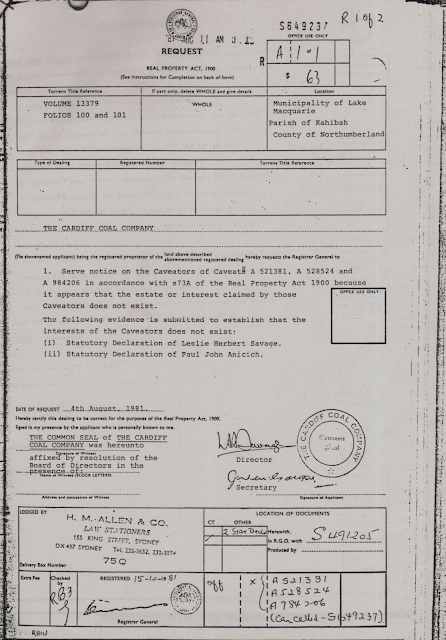
15 April 1910 ,19 April 1916, 22 August 1916, 5 October 1916, 22 November 1916, Were bogus Cardiff Coal Company meetings.1910 to 1938 –Minutes contained forged signatures and meetings that were not recorded in Wigram Allen (Company Secretary) diaries.

New Deed of Settlement bogusly adopted 1916. The Deed was typed on an English Imperial Typewriter manufactured between 1930 & 1967: (Tytell expert witness) Typeface used was not available in 1916.

5 April 1917 & 6 April 1938 Cardiff Coal Coy meetings are bogus entries in minute book.

5/4/1917 bogus date of transfer of Lunn & other shares to Blackwood.

17/12/1919 Caveat entered on title L. Blackwood, / V. Geary 13/1/1920 & J. Fletcher 24/8/1923.

2/2/1934 notified Gov. Gazette. Resumption part Por.35A CCC land for road purposes Lake M Shire.

7/4/1937 incorporation of the Belmont Colliery P/L. (Coy. obtains mining lease on Cardiff CC land)

10/5/1938 bogus transfer Blackwood shares to Belmont Colliery P/L - Stamp Duty paid in decimal currency on Transfer document. (Decimal currency was not introduced into Australia until 1966)

17/9/1948 Gov. Gaz: Part Por. 35A resumed by HDWB for water tower–Cardiff Coal Coy not found.

29/11/1971, 24/4/72, 22/5/1972, 27/11/1972, 12/2/1973 24/2/1975. Dates of Yacht Club Meetings where discussion of Cardiff Coal Co land was mentioned. - Copy of relevant Minutes available

22/12/1972 Belmont Colliery Propriety Ltd. shares acquired by Mr. Savage

17/2/1975 a company named Cardiff Coal Company Pty Ltd incorporated.

29/7/1975 a “Cardiff Coal Company” Business Name was registered.

31/7/1975 Cardiff Coal Co. Pty Ltd name was changed to Caralco Pty Ltd.

9/6/1975, 22/12/1975 22/3/1976, 10/6/1976, 23/6/1976, 23/2/77, 28/2/1977 (Yacht Club (Minutes)

17/5/1976 Mr Savage collects Cardiff Coal Company Records from office of Allen, Allen & Hemsley.

23/2/1977 Cardiff Coal Co. ‘reactivated’ by members of Savage family. L. Savage made Chairman.

25/2/1977 Application for new Certificate of Title Statutory Declaration by LH Savage Director.

1/6/1979 Real Property (Possessory Titles) Amendment Act 1979 proclaimed.

15/5/1980 Savage buys 25 Cardiff Coal shares from Harris Wheeler Williams, (T. Fenwick Estate)

13/11/81 Caveats lifted from Title on Request of LH Savage Director & JW McGregor Secretary under a seal of Cardiff Coal Company with Statutory Declarations of LH Savage & PJ Anicich.

Nov. 1982 Mr. Savage began writing to Lloyd family saying he was researching family tree. He obtained 50 Lloyd’s shares 1982). (Copies of letters are available)

3/11/1984 ‘Proposed $100 million development at Lake Macquarie’ Newcastle Herald (Cardiff Coal land).

10/11/1992 Injunction hearings to stop sale of land, See judgment Justice Bryson. (Pgs.5, 9 &10)

11/11/1992 Date when Company Interlopers sell Cardiff Coal Co. land to McCloys Pty Ltd.

14/10/1994 Interim Judgment Lunn V Savage case Finding: Forgeries proved.

10/11/1994 funds were withdrawn from Cardiff Coal Company. (Detail in Receivers Report)

11/11/1994 Date Court put a hold on withdrawal of Cardiff Coal Co funds

12/6/1996 Police charge Mr Savage with Perversion of the Course of Justice: dismissed on technical grounds.

6/9/1996 Judgment Lunn V Savage case Orders made: Shares restored, Receiver appointed, Account of dealings with property of Cardiff Coal Company to be made.

15/4/97 Receiver’s Report submitted to the Court

24/4/97 Judgment Hulme J: Part 1 & 2 Belmont Colliery never owned shares in Cardiff All transfers were forged Orders Part 1 &2 All documents be produced to Mr A Lewis Receiver.

9/3/1998 Judgment 1st Appeal CA40564/96 Dismissed

10/11/1998 Judgement 2nd Appeal CA 40564/96 Dismissed

18/6/99 Application for leave to appeal by defendants to High Court Australia Dismissed

25/10/02 Application to wind up the Cardiff Coal Company published Company Notices SMH

20/12/02 Lunn V Cardiff Coal Coy (5095/02)- Judgment Barrett J - Application Refused on technicality that NSW Law did not now recognise Cardiff Coal Company as a company.

29/8/03 Cardiff Coal Company Application to Wind up granted and liquidator appointed.

21/3/04 Supreme Court NSW No.04068 Cardiff Coal Coy in Liquidation V Sparke Helmore.

4/4/06 Supreme Court NSW No 3047/89 Order discharging the Receiver.

16/6/2009: The Cardiff Coal Company matter is still unresolved because the assets have been disposed of and income disbursed by interlopers. Liquidator & lawyers use last available funds. All Funds syphoned off between 1975/1992 have not been recovered.

For the pdf version click here: http://tiny.cc/10CD7

Tuesday, October 20, 2009

Proposed legislation that would allow arbitrary alienation of rail easements must be abandoned

See ABC TV News Report:
http://www.abc.net.au/news/video/2009/10/20/2719416.htm

T0:

Members of the NSW Parliament
Parliament House,
Macquarie Street,
Sydney NSW 2000


Dear Member of Parliament,

Thirty years ago the people of Newcastle campaigned to have their Harbour foreshore landscaped and the Coal River Convict Heritage site recognised and promoted. Progress was made but when the Honeysuckle Dev Corp was established in the early 90’s to take up the $100 Million Federal Building Better Cities money it wrongly focused on removing the whole railway when it should have concentrated on just removing the redundant industrial aspects. The improvement of the passenger rail corridor and restoration of the beautiful Newcastle Railway Station was a firm policy outlined in the official 1981 Harbour Foreshore Scheme and should have been promoted by the HDC.

The people of NSW are crying out for efficient and improved services. Not lengthened travel times and more inconvenience! The old steam Newcastle Flyer provided a more speedy connection to Sydney than the electric train services in the latest timetable!

The concept of removing passenger rail services is foolish and makes any plan that would make it easier to bypass parliament and remove rail easements is not in the public interest. Please oppose the Transport Administration Amendment (Rail Trails) Bill 2009.

Yours faithfully,

Doug Lithgow
Freeman of the City of Newcastle

Click below for Old Town Newcastle Link
http://tinyurl.com/yzomtbf

Thursday, October 1, 2009

Stockton Bight To Be Transformed Into A Wasteland


Please find below my notes for an address I gave to the Port Stephens Council back in 1994. Less than 15 years later the World famous Sand Barrier and its historic and scenic treasure is being transformed to a waste land and its sand turned to land fill and concrete by the very people who we were told would want to conserve it as their heritage.

NOTES FOR ADDRESS TO PORT STEPHENS COUNCIL
February 1, 1994

What will we call it?

Hunter River Coastal Park?
Stockton Bight Coastal Park?
Newcastle Bight National Park?
Port Stephens National Park?

Sydney Harbour has its National Park.
Gosford has its Brisbane Waters National Park.
Port Hacking has its Royal National Park.
Botany Bay has its Botany Bay National Park.
The Hawkesbury River - Broken Bay has the Ku-ring-gai National Park.
Sydney also has Blue Mountains National Park, 247 000ha
Dharug National Park 15 000ha and more.

Newcastle Bight is the Hunter Region's miniature Fraser Island - A sand dune wonderland.

It is our only chance of obtaining a national park near to the lower Hunter centre of population. Action is needed now because the threats of development could obliterate the area in the next ten years.

The pressures are: sand mining rutile, sand extraction building sand and foundry sand also silica sand for glass making, fires, urbanisation, off road vehicles.

The Challenge is :

To incorporate and dedicate all the Public Land and Crown Lands in the Bight and the areas of high conservation value over the Hunter Water Corporation Tomago Sand Beds and to prepare a plan of management that will protect.

1. not just the unique surface with its magnificent fore dunes and forested hind dunes and closed heath lands its wetlands and miniature lagoons.

2. but also the open aquifer and ground waters that are our insurance policy for the continued supply of water in times of drought or when green algae makes pumping from dangerous. The urban habitability of this area into the long term is dependent on the protection of this easily accessible ground water supply.

It is important to ensure the provision of potable fresh Water - in Drought or when there is an infestation of blue green algae (Microcystis aeruginosa)

A National Park is a special public park that is of sufficient area to protect the scenic beauty and the natural quality or unique interest of an area and make it available for all to enjoy without impairing its distinctive qualities.

Port Stephens is an attractive area and the Newcastle Bight the sand dunes, sand beds and volcanic hills are its distinctive scenic features.

The holiday wonderland of our region - clear skies, clear water, and natural beauty.

The Challenge of the future is to keep it wonderful.

The fresh water in our open aquifer needs it protecting mantle of nature.

The trees shrubs and wild places that have constantly replenished it and protected it since time immemorial.

We can enjoy the natural beauty of the landscape and still maintain the quality of the underground water supply if we are able to establish a National Park and manage it properly.

The Challenge is to manage all our activities with a comprehensive plan of management that acknowledges the sensitivities and the potential but ensures that our activities do no permanent damage.

We have reserved land for military, water and forestry purposes but we have no reasonable sized National Park.

Sydney's great National Parks - Royal National - 15 h Dedicated 1879 1.3million people visited last year

Ku-Ring-Gai Chase - 14 838ha Dedicated 1894 1.2million people visited last year

The population of Sydney was less than the current population of the lower Hunter when these parks were dedicated.

Sydney's 2 great National Parks can be reached by public transport and are within a 23km radius of the harbour bridge.

We have Glenrock SRA - 478ha Not 4 000 or 15 000 and

Tomaree NP - 896ha Not 8 000 or 15 000

Why are there no reasonable sized National Parks in the Lower Hunter.

Do we not care about our great assets for some reason?

Perhaps we are unable to make our voice heard in the corridors of power. Perhaps Sydney has been lucky to have so many local government councils?

The Challenge is the establishment of a Coastal National Park in Port Stephens before the pressures become to great.

We would like to establish a centre for coastal management on the Bight.

We need to study the whole Bight.

We all need to get to know the facts about this unique natural system in its wholeness - solve the incompatible use problems - and together we will make sure our voice is heard.

Doug Lithgow
President
Parks and Playgrounds Movement

Wednesday, September 9, 2009

Stockton Bight Sand Dunes by Mr Kevin Markwell [Newcastle Herald Thursday, 1st March 2001]

STOCKTON BIGHT
by
Mr Kevin Markwell

[Newcastle Herald Thursday, 1st March 2001]

The somewhat belated announcement by Premier Carr last week announcing a conservation area in the Stockton Bight was bound to be met with a mixed response, given the range of stakeholders with competing interests in this valuable area. Aboriginal groups, recreationists including four wheel drive enthusiasts, fisherfolk, birdwatchers and bushwalkers, conservationists, tour operators and mining companies each value Stockton Bight for different reasons and each seeks a particular form of relationship with it. Some of these relationships are in direct conflict with others and are difficult to resolve. There has, however, been a long standing intention by various conservation groups to have the area reserved as national park as far back at the early 1970s. Whilst Bob Carr signaled his intention to create a national park there in his first term of office, he may well have been rather too optimistic about resolving the various interests in this area so quickly.

However, by creating a conservation area comprising three types of protected natural area, that is, national park, state recreation area and regional park, together with land leased back from the Woromi people, the Government has recognised the complex task of accommodating competing interests while at the same time attempting to minimise environmental impact, as well as disturbances to the various user groups. No doubt, these ideals were also tempered by a generous dollop of political reality – four wheel drive enthusiasts and fisherfolk are becoming as politically astute these days as conservation groups, and to have proposed a form of land tenure which effectively ‘locked’ these groups out of the Stockton Bight area altogether would not have been very wise electorally. Significantly, the government has also recognised the interests of local Aboriginal people through the 800 hectares of land which will be leased back from the Woromi people, the guarantee of five field officer jobs for local Aboriginal people, and in the establishment of a Management Board which will involve both Aboriginal people and NPWS personnel. Whilst such arrangements have been in existence for some decades in the Northern Territory, NSW has only begun to formally involve Aboriginal people in park management comparatively recently.

For those of you who have not had the pleasure of visiting this incredible landscape stretching for about 30 kilometres from just north of Stockton, where the Sygna wreck lies quietly disintegrating, up to Birubi Point in the north, it might be difficult to understand what all the fuss has been about. I’m sure many of you will have glimpsed the peaks of the dunes as you drive up through Williamtown on your way to Port Stephens, but to really appreciate the area you have to venture into the active dune system itself. For most first-time visitors to the area, it would be the sheer size and extent of the sand dunes which would probably have the greatest impact. These massive forms, sculpted by the forces of wind and rain, immediately impose a sense of scale which one doesn’t easily experience in other local environments. You truly have a sense of being in a wild place made up of mobile sand dune, freshwater wetland and the cooler calmer woodlands and forests on the more sheltered and stable inner dunes. A diversity of native animal species inhabit these ecosystems, the presence of many given away by the impressions left by their feet as they move across the dunes in search of food or each other.

A group of students I took to the Bight last year as part of a fieldtrip investigating recreational use of natural areas in the Hunter region were literally staggered to think that such an awesome landscape existed so close to Newcastle, and yet virtually none had ever known that it existed. The spectacularly crisp contrast of the crest of an enormous white sand dune in stark relief against a cobalt blue sky is something that has to be seen to be believed. Imaginations are often magically liberated in such wild places, and my students spent their time on the dunes prowling over them trying to identify the marks left in the sand by the various animals which live there (the camel footprints really had them stumped), playing as if they were

young kids again, and sitting down in quiet contemplation, looking out across dune and scrub towards the Pacific Ocean. As a place for recreation and tourism activities, the Stockton Bight area has much to offer.

Managing the area will be far from an easy task, and ensuring the correct form of activity within each of these ‘zonings’ is likely to pose considerable problems for the National Parks and Wildlife Service, especially over such a relatively small piece of land. For example, dogs are permitted within regional parks, but are not permitted in national parks, so efforts to exclude dog owners from walking their pets within the national park, when they can do so in adjoining land designated as regional park will be difficult to enforce. Of course the native birds and lizards won’t understand the subtle differences in land tenure!

At the moment, however, the area is largely unknown by the majority of its residents. But, with the designation of the conservation area, this could change dramatically over the next few years. The area is bound to increase in significance to tour operators based in Newcastle and Port Stephens, and already camel rides, expeditions in huge four wheel drive trucks and trike rides are available. The demand for activities which involve a bit of risk in such an awesome landscape will no doubt grow rapidly, and there are dangers in this. Uncontrolled and unregulated, tourists and recreationists can cause severe and lasting damage to natural environments, particularly those which for whatever reason are a little more fragile than others. The Stockton Bight ecosystem is one such fragile environment, which is so vulnerable to the natural erosive powers of wind and rain, the effects of which can be exacerbated through unsuitable activities such as inappropriate vehicular access and use, overcrowding, and even trampling from too many bushwalkers. Of course the sense of being in a wild place is also shattered immediately by the sounds of four-wheel drive vehicles and by RAAF jets flying so low overhead, and it is no easy matter, as the government well knows, to manage the intrusiveness of sound!

Given that the local tourism industry (and the broader economy generally) is likely to benefit from the declaration of the conservation area, I would like to think that the local industry declares its support for ecologically sustainable forms of tourism in this area. I often feel that the tourism industry doesn’t play an active enough role in lobbying for the establishment and management of protected natural areas, even though it gains much from these areas. There are of course some innovative examples of tourism and environmental conservation working in partnership, and here I am referring to The Dream Project sponsored by key players in the Dolphin Tourism Industry of Port Stephens, and some of the more environmentally aware accommodation providers in the Dungog area, but I think there is more room for the tourism industry to support conservation efforts. Greater involvement by representatives of the tourism industry in the earlier stages of such proposals would I think establish a commitment to sustainable tourism and recreation initiatives. I remain optimistic that an achievable partnership between the various interest groups and stakeholders involved with Stockton Bight can be negotiated and that management of the variety of recreational and tourist activities can occur in a sustainable way, so as to ensure the long-term protection of this area’s significant natural and cultural values.

Kevin Markwell